
GCUC UK Blog
The danger of guessing: Why we need real flexible workspace data
- Coworking
- Industry

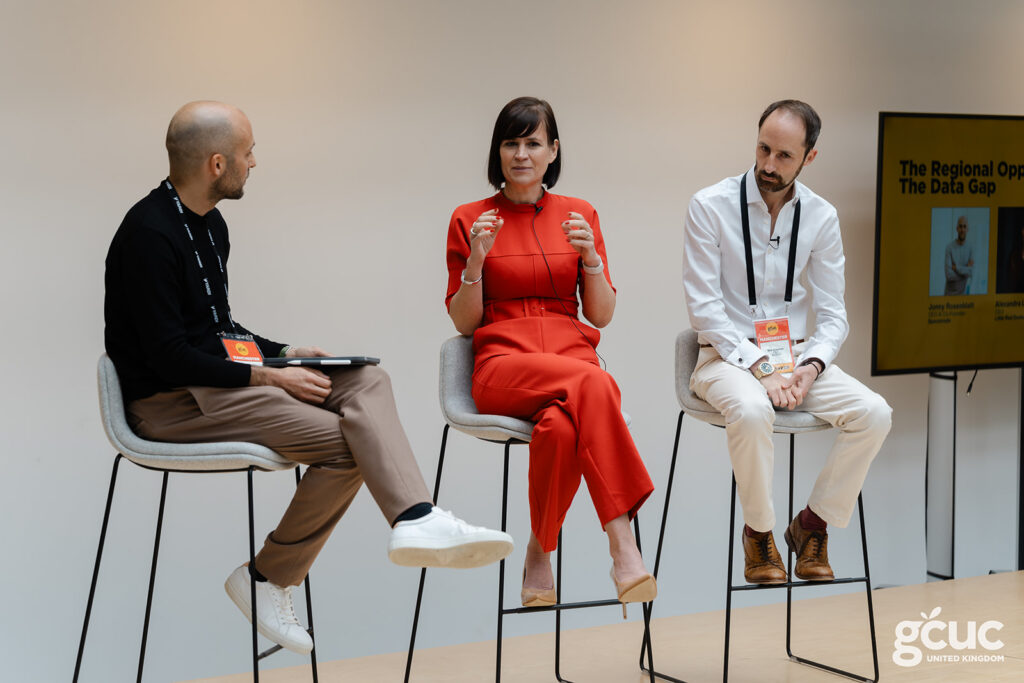
The argument for regional flex tends to be made in London, by people looking outward. At GCUC UK Manchester, a session called The Regional Opportunity + The Data Gap flipped that on its head, handing the floor to operators who have actually built and scaled outside the capital.
It was part market analysis, part panel, part call to action, and it was entirely candid about the sector’s biggest weakness: it cannot yet prove its own numbers.
Jonny Rosenblatt of Spacemade opened with the case for WIN (the Workspace Intelligence Network), the operator-led data collective, and named the problem it exists to solve.
“There is no central source of truth in our sector. Everyone says they’re 75% let after six weeks. We all know it’s a bit of a nonsense.”

WIN pools occupancy, revenue, and cost data from operators and anonymises it into shared benchmarking. The London dataset is now deep, but the regional one is not yet. That is precisely the gap Rosenblatt came to highlight, because any pool of flexible workspace data is only ever as good as the number of operators willing to feed it.
His argument for contributing went far beyond self-interest, straight to the commercial credibility of the whole sector.
“The only way to really do this is to institutionalise ourselves. We’re often looked at as the poor cousin of the real estate sector.”
What real regional market data tells us
When you actually look at the real, unvarnished regional metrics, the picture is incredibly nuanced. The latest WIN reports show Bristol holding strong and stable with occupancy just under 93%, signalling that operators there should be confidently pushing their desk rates.
Meanwhile, Birmingham has seen a softening in ancillary revenues, and Manchester sits just above 75% after a challenging year, with its clear growth lever being ancillary revenue rather than desk rates.
These are the exact kinds of insights that operators miss when they rely on guesswork or high-level broker reports instead of actual flexible workspace data.
Using industry benchmarks to educate investors
Having accurate data isn’t just about tweaking your daily rates, it is about surviving contact with outside investors. Alexandra Livesey (Little Red Donkey) explained why traditional real estate still struggles to value flex assets.
“They value it as a highly fluctuating revenue stream, so the valuation is uncertain, and it drifts down towards zero. First you have to educate them.”
Her point lands even harder when you look at the reality of member behavior. Regional flex member tenure actually sits between 26 and 38 months, a timeline that behaves much more like a traditional commercial lease than a volatile hospitality stay.
Yet, without centralised flexible workspace data to prove it, traditional property investors continue to value that revenue as if it could vanish overnight.
Scaling without dropping desk rates
Ben Cheriton of BLOCK, opening sites city by city, made the case that local knowledge cannot simply be copied and pasted.
“You don’t create a corporate look and feel office in the middle of the Northern Quarter. You’ve got to really understand how a space lives and breathes.”
His approach is to hire local leadership and let each site take on the character of its city, while keeping brand and product quality consistent. On entering a market, he is firm that you compete on being the best product or the best value, not by quietly dropping your desk rate to buy short-term occupancy and hoping to claw it back later.

Why processes and governance underpin true growth
Alexandra closed on the least glamorous and most important point, which is what actually keeps a growing business standing up.
“It’s processes and governance for me. It’s the boring things that, if they’re not looked after during scaling, are where businesses fail.”
The takeaway is clear: the sector grows up by measuring itself honestly and realistically.
That is exactly the level of commercial reality we are bringing to GCUC UK London on 8 October. We are not hosting vague talking points, we are getting right into the hard numbers, the 2026 business rates revaluation, and the operational plays that are keeping margins sustainable.
Early Bird rates close this Friday 24 July, saving you up to £150 per ticket. If you’re ready to stop guessing your Q4 strategy and start working on your business with the people who truly understand the numbers, lock in your passes today.